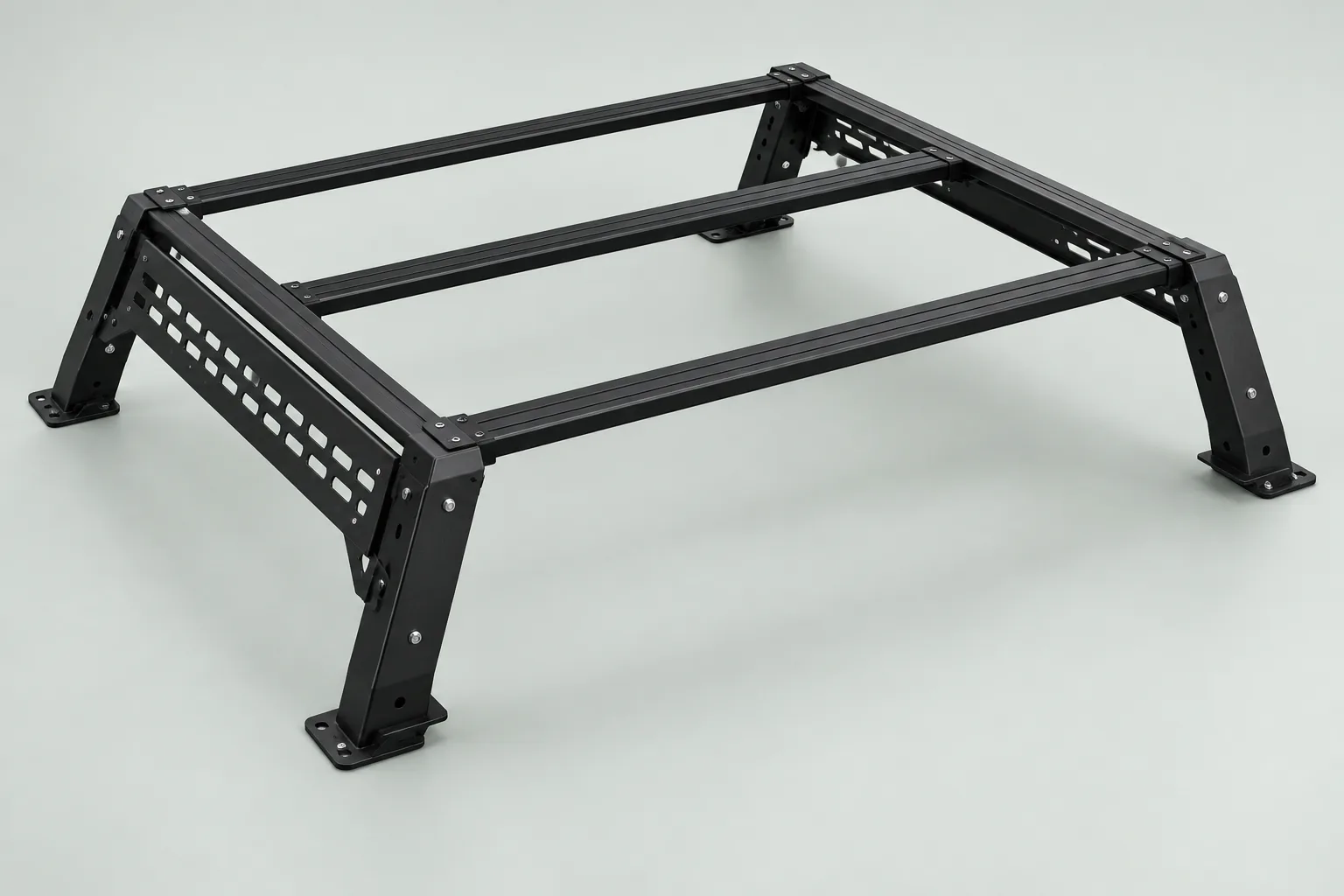
Roof Racks & Overlanding Accessories from China
A roof rack may look like a straightforward collection of rails, crossbars, brackets, and fasteners. For an aftermarket brand, however, it is a vehicle-mounted system that carries real loads through several interfaces. The price of a rack is only meaningful if the entire assembly is appropriate for its intended vehicle and use.
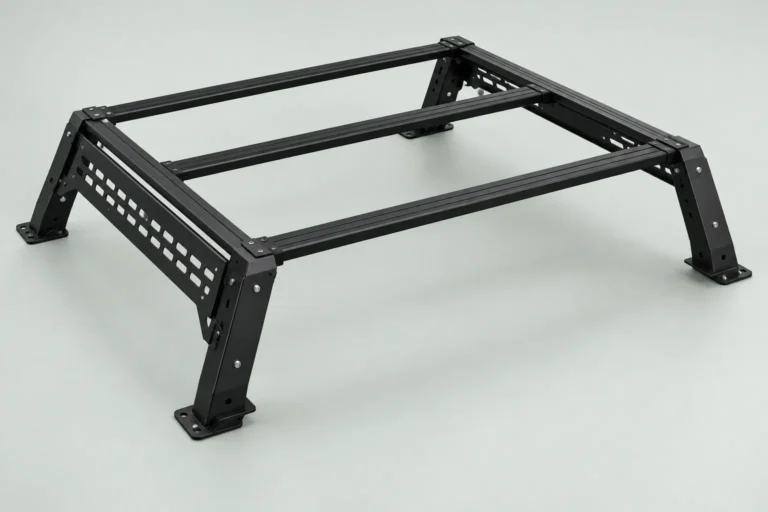
That distinction matters especially in overlanding. Buyers may be sourcing low-profile roof platforms, crossbars, awning mounts, cargo storage accessories, or custom brackets for SUVs, pickups, and 4×4 vehicles. Suppliers may offer many similar-looking options, but their attachment systems, testing histories, coatings, and quality controls can differ substantially.
This guide sets out a practical procurement method for overseas distributors, private-label brands, and eCommerce businesses sourcing roof racks and overlanding accessories from China. It explains how to define fitment, evaluate load claims, compare manufacturing methods, organize sample testing, and prepare a quotation that can actually be compared across factories.
Important distinction: A sourcing coordinator can organize information and evidence; only qualified designers, testing organizations, and responsible product businesses can establish that a safety-relevant roof system is appropriate for an identified application.
In this guide
In this guide
- Explore Related Parts Categories
- 1. Know exactly which roof and cargo products you are sourcing
- 2. Vehicle fitment is a geometry problem, not a catalog claim
- 3. Understand the full load path before accepting load ratings
- 4. Which roof-rack standard should buyers ask about?
- 5. Compare material and construction choices
- 6. A useful tolerance stack-up review
- 7. Qualify an actual manufacturer, not a set of marketplace photographs
- 8. Make a sample plan that examines the complete installed kit
- 9. Quotation pitfalls that distort roof-rack pricing
- 10. Avoid dangerous marketing shortcuts
- 11. A roof-rack sourcing RFQ template
- 12. What happens after the first approved order?
- Frequently asked questions
- Final buyer takeaway
- Sources and further reading
Explore Related Parts Categories
Use the relevant category to prepare a product brief, then select the sourcing support you need.
1. Know exactly which roof and cargo products you are sourcing
Not every product marketed as “overlanding accessories” needs the same engineering review. Separate them early in the sourcing process:
| Product | Main buyer concern |
|---|---|
| Vehicle-specific roof platform | Mounting points, complete-system load path, roof clearance |
| Crossbar assembly | Rail interface, clamp engagement, spacing, retention |
| Roof basket or cargo tray | Attachment to bars/platform, vibration, containment |
| Awning mounting bracket | Cantilever loading, deployment configuration, fasteners |
| Recovery gear or shovel mount | Retention under driving vibration and emergency loads |
| Cargo drawer or organizer | Vehicle floor interface, restraint, sliding hardware |
| Decorative rack trim or end cap | Fit, UV resistance, material, finish |
A supplier experienced in decorative extrusions is not necessarily qualified to validate a structural roof-rack assembly. Conversely, a supplier making tested complete racks may subcontract aluminum extrusion and powder coating while retaining genuine product-development capability. Determine who designs, makes, assembles, tests, and approves each part.
LedgeGear 4×4’s Overlanding & Cargo Systems sourcing page describes product categories buyers may ask suppliers to quote; it does not represent stocked inventory or approved applications.
2. Vehicle fitment is a geometry problem, not a catalog claim
A rack described as fitting an entire SUV model series may overlook changes between trims, production years, roof styles, or vehicle markets. A panoramic roof, factory flush rails, raised rails, mounting bosses, roof-channel plugs, antennas, and crossbar positions can change how the rack is installed.
For each vehicle application, create a fitment matrix covering:
- Vehicle make, model, generation, production/model years, and market.
- Body configuration, roof type, and relevant trim differences.
- Factory mounting-point coordinates and usable thread engagement, where applicable.
- Roof curvature, panel clearance, and accessory interference zones.
- Rail type and required crossbar or platform spacing.
- Required gaskets, isolators, spacers, and protective pads.
- Installation tools, fastener types, and tightening procedure.
- Explicit exclusions and untested configurations.
Do not rely entirely on an OE reference or online fitment list. An OE part number can identify a relevant interface, but the rack may require an installation method quite different from the original equipment. Request dimensioned drawings and a documented installation trial on the intended vehicle or a justified equivalent fixture.
Example of a fitment failure: A sample platform aligns with the visible roof-channel openings, yet the supplied spacer stack prevents a bolt from reaching its intended engagement depth. A photo of the rack installed is not proof that the fastening system is adequate. The buyer should compare the drawing, fastener engagement, approved torque procedure, and vehicle installation requirements with competent technical personnel before approving the product.
3. Understand the full load path before accepting load ratings
The load path follows cargo through accessories, crossbars or a platform, brackets, fasteners, and vehicle mounting points into the vehicle structure. Each element—and the vehicle manufacturer’s roof-loading limits—matters. A stronger aluminum bracket does not automatically make the vehicle roof capable of carrying a greater load.
Three rating categories often appear in supplier marketing:
Dynamic roof load. The load carried while the vehicle is moving, including the effects of acceleration, braking, cornering, road shock, and vibration. The relevant capacity depends on the installed configuration and vehicle constraints.
Static roof load. A load in a stationary condition, sometimes cited in rooftop-tent marketing. A static figure should not be substituted for the vehicle’s driving limit, nor should it be accepted without a defined test configuration and method.
Off-road operating conditions. Rough-terrain vibration, impacts, body movement, and high center of gravity can create additional demands. A supplier’s on-road rating or bench load does not automatically validate severe off-road use.
A practical buyer rule is to treat a system’s safe capacity as constrained by its weakest applicable element, including vehicle limits, the complete rack, adapters, and mounting components. That is a decision framework rather than a tested capacity calculation. The final permissible load must come from valid engineering and manufacturer guidance for the complete configuration.
Ask the supplier for the test report rather than only the catalog figure. The report should identify:
- Exact rack model and drawing revision tested.
- Vehicle or representative test fixture and all mounting hardware.
- Sample quantity and test methods.
- Load locations, directions, magnitudes, durations, and acceptance criteria.
- Test outcomes, observed deformation, and failure modes.
- The laboratory or responsible test organization and report date.
- Limitations on additional accessories, configurations, or off-road use.
If the evidence relates only to an isolated bracket, label it as component evidence, not proof of complete-system capacity.
4. Which roof-rack standard should buyers ask about?
ISO 11154:2023, Road vehicles — Roof load carriers, specifies requirements and test methods for roof racks within its defined scope, including passenger cars and qualifying light commercial vehicles. ISO also published Amendment 1 in 2025. Buyers should identify the current version and applicability before referencing it in a purchase specification.
This standard is useful as a technical discussion point; it is not a universal legal certification or a promise that every overlanding configuration is covered. An accessories bracket, cargo drawer, or non-standard roof system may need a different analysis and additional testing. Ask suppliers to identify the actual tests performed against the relevant clauses and to produce traceable results. “ISO compliant” printed in an online listing is not enough.
Official references: ISO 11154:2023 and Amendment 1:2025.
5. Compare material and construction choices
Extruded aluminum
Extrusions support repeatable profiles, mounting channels, and comparatively low mass. However, alloy and temper, wall thickness, section geometry, local machining, and joint design all affect performance. A vendor statement such as “aircraft-grade aluminum” is not an actionable engineering specification. Ask for the actual alloy/temper, mill documentation where appropriate, and the approved profile drawing.
Welded steel
Steel designs can be attractive for certain rugged configurations, but gauge, weld quality, corrosion treatment, and finished weight require attention. Where parts are welded, define weld locations, accessibility, finishing, inspection, and relevant structural acceptance requirements. Do not infer fatigue strength from a neat-looking weld bead.
Fasteners and isolators
Some rack failures originate in apparently minor components: washers, thread engagement, incorrect bolt grades, missing lock features, poorly designed rubber pads, or unsuitable combinations of dissimilar metals. Define specifications for every fastener and spacer, not just the visible rails. Tightening instructions should be validated for the real vehicle interface, not copied from a generic catalog.
Finish and exposure
Powder coating, anodizing, and plating must be evaluated against the actual exposure profile. Coastal environments, mud, road salt, and contact between dissimilar metals introduce corrosion risks. Buyers should ask what substrate preparation is used, how edges and welds are covered, and whether a claimed salt-spray result corresponds to the production finish. Salt-spray hours alone do not predict exact real-world service life.
6. A useful tolerance stack-up review
A roof platform can be composed of ten or more nominally acceptable components but fail during assembly because their tolerances accumulate in the wrong direction.
For example, total mounting-stack height depends on bracket thickness, coating, spacers, isolators, and vehicle interface variation. Similarly, rail hole patterns may depend on laser-cut plate tolerances, extrusion straightness, and jig positioning. Drawings should identify critical dimensions and datums, not just show attractive three-dimensional product views.
Ask the supplier to assemble a complete sample from production-intent components, record the amount of adjustment available, and document final alignment. If the installation depends on forced bending, unapproved drilling, or elongated holes not shown in the design, treat that as a redesign issue—not a normal installation technique.
7. Qualify an actual manufacturer, not a set of marketplace photographs
A useful supplier review identifies the functions performed by the vendor: extrusion sourcing, CNC work, stamping, tube bending, welding, coating, packaging, or final assembly. Some factories specialize in only one of these. Outsourcing is acceptable when controls are clear, but the responsible supplier needs visibility into subcontractor changes.
Ask the factory or supplier to explain:
- Which product drawings it owns and may legally supply.
- Whether tested models are the same as the models on quotation.
- The manufacturing and finishing processes for each major part.
- How raw materials, fasteners, and coating lots are traced.
- How jigs are verified and rechecked after maintenance.
- What changes trigger new sample or qualification testing.
- Whether it can supply replacement hardware and installation instructions.
- How complaints are contained, investigated, and corrected.
Quality-system certifications, if presented, should be checked for scope and authenticity. They are supplementary evidence, not a substitute for product testing.
8. Make a sample plan that examines the complete installed kit
An effective sample program has several gates.
Gate 1: drawing and bill-of-material review. Confirm dimensions, bill of materials (BOM), finish, mounting interfaces, and version identifiers before ordering sample kits.
Gate 2: incoming kit audit. Check actual supplied parts against the packing list. Count each bolt, washer, gasket, end cap, and installation tool. Missing small hardware can stop a customer’s installation.
Gate 3: dimensional and finish inspection. Measure high-risk holes, slot positions, bracket flatness, rail straightness, and finish continuity. Do not inspect only the easiest dimensions.
Gate 4: installation and clearance trial. Use the intended vehicle application where feasible. Check roof clearance, weather seals, antenna and sunroof movement, and approved hardware engagement. Record conditions and who performed the review.
Gate 5: independent qualification where required. Obtain appropriate load, vibration, corrosion, or environmental testing through qualified technical parties for the intended claims.
Gate 6: packaging and transit. Assemble and repack the kit to assess scratches, part separation, sharp-edge protection, carton strength, and damage to long profiles during handling.
A “golden sample” should be identifiable by SKU, revision, date, and sign-off. Protect it from being silently replaced when the supplier changes materials or coating.
9. Quotation pitfalls that distort roof-rack pricing
A quote of $X per rack is not comparable unless the rack configuration is identical. Differences frequently include powder-coat finish, number of crossbars, side-rail design, stainless versus other fasteners, vehicle brackets, hardware bags, branding, and packaging dimensions.
Define whether the price includes engineering work, new dies or jigs, sample test costs, logo application, user instructions, spare hardware, and retail packaging. Ask whether MOQ applies per model, finish, bracket variant, or total combined order. Specify whether the buyer owns any paid tooling and whether the supplier may reuse customer drawings or branding.
For bulky products, carton cube can be as important as factory price. A rack shipped fully assembled may use substantial container space; knock-down packaging can reduce cube but increases installation steps, packing complexity, and missing-parts risk. Request packed dimensions, gross weight, configuration photographs, assembly time estimates, and protective packaging specifications. Compare delivered cost per saleable kit rather than the EXW unit price alone.
10. Avoid dangerous marketing shortcuts
For a roof system, statements such as “universal fit,” “supports 300 kg,” or “safe for any rooftop tent” are product claims that need exact applicability and evidence. An unqualified static number may be mistaken by consumers for a driving-load limit. A factory load test on its own fixture does not necessarily validate installation on every advertised vehicle.
Similarly, a product should not be marketed as factory approved, genuine OEM, DOT approved, or independently certified without substantiation. Installation instructions, weight labels, warnings, product liability arrangements, and recall preparedness deserve attention even for products without a dedicated product-specific US FMVSS. NHTSA has long noted that aftermarket motor vehicle equipment may be subject to safety-defect responsibilities even when no specific FMVSS applies.
For a private-label brand, the technical reviewer and legal adviser should determine the claims that can be made and the exact product scope of supporting documentation.
11. A roof-rack sourcing RFQ template
A strong supplier inquiry can use the following fields:
| RFQ section | Requested information |
|---|---|
| Product | Platform, crossbar, basket, or accessory; exact configuration |
| Vehicle fitment | Make/model/year/roof style/market and exclusions |
| Interface | Mounting coordinates, bracket drawings, fastener specification |
| Material | Alloy, temper, steel grade, thickness, profile details |
| Finish | Pretreatment, coating type, color, appearance tolerance |
| Load claims | Intended conditions, acceptance criteria, supporting reports |
| Assembly | BOM, included hardware, installation guide, replacement parts |
| Samples | Complete kit, drawing revision, trial-fit and test plan |
| Commercial | MOQ by variant, tooling, sample charges, lead time, Incoterm |
| Packaging | Packed dimensions/weight, drop-protection plan, brand markings |
| Change control | Approval required for materials, tooling, design, finish, supplier changes |
The strongest replies identify missing information and propose verification steps. Be cautious of sellers who provide an immediate load-rating promise without knowing the intended mounting configuration.
12. What happens after the first approved order?
Maintain a version-controlled SKU record for all vehicle applications. Record changes to powder-coat subcontractors, mounting hardware, jigs, rail profiles, and installation documents. Request lot markings when appropriate to support investigations. Retain field complaints and inspect whether they involve corrosion, noise, vibration, fitment, shipping damage, or user misunderstanding.
For eCommerce channels, a comprehensive compatibility table and clear installation exclusions may prevent more expensive returns than a small unit-cost reduction. Wholesale distributors should also consider packaging designed for repeated warehouse handling and field support for installers.
Frequently asked questions
Can you buy a universal roof rack from China for multiple SUVs?
You may be able to source adaptable hardware, but “universal” is not proof of safe fitment. Define the intended vehicle interfaces and validate each application or justified application family. Distinguish adjustable components from a validated complete assembly.
What is the difference between static and dynamic load ratings?
Static claims concern a stationary condition; dynamic claims concern driving conditions. They are not interchangeable, and neither automatically supersedes the vehicle manufacturer’s roof limitations. Always check the complete configuration and evidence.
Does ISO 11154 certification make a roof rack legal in the US?
ISO 11154 is a technical roof-carrier standard within a defined scope, not a blanket statement of US legal approval. Whether a product requires particular testing or meets applicable laws depends on the item and intended use.
Are aluminum roof racks always better than steel?
No. Total weight, corrosion protection, section design, joints, failure modes, repairability, cost, and intended loading all matter. Material marketing claims cannot replace a complete-system comparison.
Can a sourcing company guarantee roof-rack load capacity?
A sourcing company can help obtain drawings and supplier reports, coordinate samples, and arrange discussions with testing providers. A validated capacity requires competent engineering and appropriate application-specific evidence—not a sourcing quotation.
Final buyer takeaway
Roof-rack sourcing is fundamentally about application, load path, manufacturing control, and proof. Buyers who evaluate these before committing to production are better positioned to build a private-label range that is supportable after sale.
LedgeGear 4×4 can help clarify specifications, research candidate manufacturers, compare quotation details, and coordinate supplier questions or sample revisions. The buyer retains engineering approval and commercial decisions. Explore our Overlanding & Cargo Systems category or send your product brief to discuss a defined sourcing task.
Start with a rack layout, bed measurements, a reference photograph or your own mounting drawing. LedgeGear 4×4 can help research manufacturers for an existing rack or a custom design, then coordinate quotations, prototypes, changes and agreed production updates. Explore custom manufacturing coordination or discuss your sourcing project.
Sources and further reading
- ISO — Road vehicles: Roof load carriers, ISO 11154:2023
- ISO — ISO 11154 Amendment 1:2025
- NHTSA — Aftermarket motor vehicle equipment and safety-defect duties
- ICC — Incoterms 2020
Editorial note: Engineering examples in this guide illustrate procurement questions, not approved designs or tested ratings. Obtain qualified validation before making safety or load-capacity claims.