Factory Sample Approval for Custom 4×4 Parts: First Article and Production Release
Approving a custom off-road component is not the same as liking its sample photograph. A prototype may have the right appearance while its mounting holes, material, fastener kit, coating or vehicle clearance are wrong. For buyers sourcing 4×4 parts from China, sample approval should be a documented decision with measurable requirements and a traceable drawing revision. That is especially important for racks, protection panels, mounts and assemblies installed near factory sensors or structural interfaces. This guide outlines a practical first-article and approval process, while keeping safety engineering and regulatory responsibility with the appropriate qualified parties.
Important: These are generic buyer procedures and illustrative scenarios. No live supplier arrangement, case-study result, safety rating or legal conclusion is claimed. Engage relevant engineers, labs and legal professionals as appropriate.
In this guide
- Agree what the sample is supposed to prove
- Identify the controlled drawing revision
- Choose critical-to-fit dimensions
- Check material evidence and bought-in components
- Review fabrication and finishing separately
- Arrange vehicle-specific trial fitting
- Distinguish cosmetic from safety-related findings
- Use photographs as evidence, not as the entire report
- Plan corrective action and resampling
- Separate first-article approval from production authorization
- Packaging is part of the approved product
- What to do before a repeat order
- Illustrative sample approval scenario
- Copyable release checklist
- Frequently Asked Questions
- Further Buyer Resources
Agree what the sample is supposed to prove
An early concept prototype may establish basic shape or installation feasibility. A manufacturing-intent sample may need to demonstrate controlled material, fixtures, welds, finish and kit contents. A pilot batch examines repeatability, assembly and packing across more than one unit. Do not label all three simply ‘sample approved.’ State the stage, the open questions and the exact evidence required to move forward. A buyer can accept a concept for design development while expressly withholding authorization for production or marketing claims.
Identify the controlled drawing revision
Every sample should be connected to the actual design package used to make it. Record part number, revision, date, material, finish and assembly references. If a supplier modifies the geometry to suit manufacturing, ask for a marked change and written buyer approval. A revised STEP file without an updated inspection drawing can create confusion over which dimensions govern acceptance. Keep supplier comments and the decision record with the same sample ID. Photograph labels and included hardware before any trial fit so the kit can be reconstructed.
Choose critical-to-fit dimensions
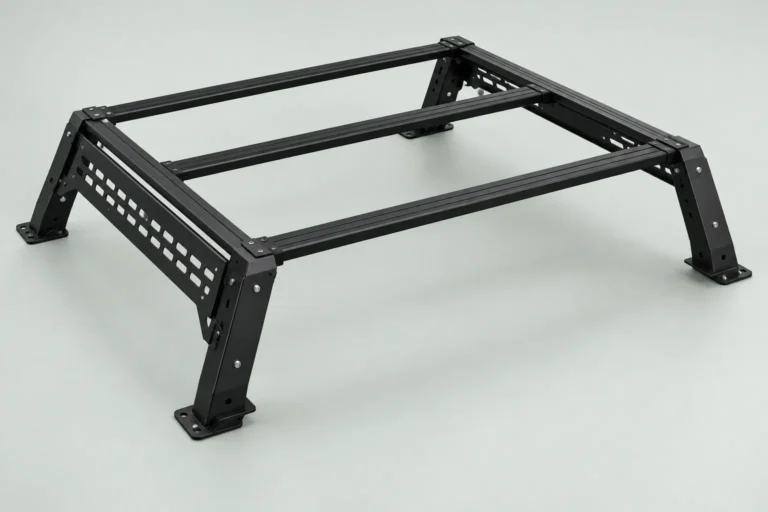
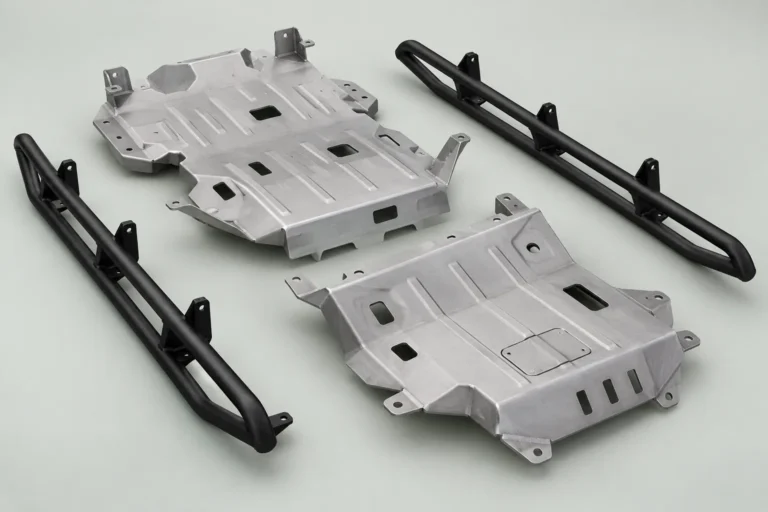
Not every dimension deserves the same scrutiny. The buyer and relevant engineer should identify mounting datums, hole positions, interfaces, edge distances, clearance and any features that affect assembly. For a bed rack, rail clamps and fastener access may matter more than a purely cosmetic bend. For a skid plate, frame mounting positions and service openings are high priorities. Ask the supplier to report actual measured values and the method, not simply mark everything ‘OK’. A good first article uses a defined reference coordinate system and documented tolerances.
Check material evidence and bought-in components
Verify that the proposed material and thickness match the accepted design or approved substitution. Depending on risk, the buyer may require appropriate material certificates, independent verification or traceable manufacturing records. Check not only the metal part but also the fasteners, bushings, seals, purchased hinges, wiring or sliding elements supplied in the kit. An otherwise accurate bracket can fail to install because the hardware bag contains the wrong fastener length. Inspection criteria should include count, specification and supplier-provided assembly instructions.
Review fabrication and finishing separately
Cutting, forming and welding can introduce distortion, sharp edges, burrs, damaged threads or inaccessible joins. Powder coating and other finishes can change hole sizes and contact areas. Review the uncoated geometry where appropriate, then repeat functional checks on the finished component. Examine weld accessibility and protective finish at corners, seams and recesses. A visually even coat is not evidence of corrosion durability; requested environmental testing needs a defined method and responsible reviewer. Record defects with photos and locations so factories can correct the process rather than debate descriptions.
Arrange vehicle-specific trial fitting
An off-road accessory shown on a vehicle in an image is not automatically verified across the claimed fitment range. Use the exact make, year, trim, bed length and relevant modifications for trial installation. Check the actual mounting points, factory sensors, wires, panels, tailgate or door movement, tire clearance and tool access. Confirm who supplies the test vehicle, who supervises installation and how results are captured. If the sample cannot be fitted to a real vehicle during the current stage, explicitly mark fitment unverified and do not release a broader compatibility claim.
Distinguish cosmetic from safety-related findings
A finish blemish, missing instruction sheet and out-of-position structural mounting hole do not carry the same risk. A deviation log should record severity, expected condition, observed result, evidence, proposed correction, assigned owner and required retest. Safety-critical components and load-bearing features may require calculations or independent physical tests. A sourcing partner can coordinate the questions, but should not convert a factory’s verbal assurance into an engineering sign-off. Buyers must decide which findings block production and which can be resolved under documented conditions.
Use photographs as evidence, not as the entire report
Photos help show assembly, measurement setup, finish and packaging, but scale and interpretation can be misleading. Pair images with sample ID, drawing revision, measurable dimension and an inspection result. Avoid ambiguous photo sets in messaging apps without filenames or context. For multi-piece kits, record the sequence of assembly and every supplied fastener. If an independent inspection provider is appointed, define its scope and whether it is reviewing dimensions, appearance, packing, functionality or some combination. Do not state that third-party inspection happened unless it truly did.
Plan corrective action and resampling
A factory correction may change material, geometry, fabrication method, coating or purchased hardware. Determine whether that change requires a new sample, partial reinspection or independent retest. Send one controlled change list instead of multiple contradictory chat messages. Ask the manufacturer to return a revised drawing and explicit disposition of each open item. The buyer should sign off the final technical version only after receiving required evidence. Some changes affect unit cost, tooling and lead time; these commercial effects also need written approval.
Separate first-article approval from production authorization
The buyer may approve an individual sample while still needing a production plan, packaging test, supplier quality controls and quantity agreement. State whether the approval is for geometry only, finished appearance, pilot batch, manufacturing process or final production release. Define how the approved ‘master sample’ is kept and compared to later output. In a purchase order, reference the exact accepted revision and applicable sample/inspection documents. Factory production should not begin solely because someone wrote ‘looks good’ under a photograph.
Packaging is part of the approved product
Rack rails and steel plates can be damaged in transit even when the fabrication is correct. Sample one realistic packing configuration with edge protection, part separation, hardware bags, instructions and required labels. Consider carton size, handling and mixed-variant packing. Record what happens when the package is opened. A shipping problem that scratches every part or mixes left/right brackets can create rework, returns and customer dissatisfaction. Where packaging is private-label, review artwork and document its approval separately from the technical component.
What to do before a repeat order
Retrieve the latest approved drawing, BOM, finish reference, hardware specification, first-article record and deviation history. Ask whether the factory has changed its production process, subcontractor, material supplier or assembly instructions. Reconfirm the target model-year application and variant identifiers. The aim is not to repeat a large development project for every order, but to prevent silent changes from eroding the approved design. Define the inspection basis and communication milestones for the new batch.
Illustrative sample approval scenario
A pickup accessory brand receives a coated bed-rack mounting foot made to Revision B. During a buyer trial fit, the bracket fits the rail but obstructs a tonneau cover latch. The buyer logs the clearance issue, submits photographs with a measured dimension and requests Revision C. The new sample is checked for the modified interface, fastener inventory and coating. Production is not authorized until the responsible buyer and any required engineer review the final evidence. This is a hypothetical workflow, not a completed LedgeGear 4×4 case.
Copyable release checklist
Sample ID and controlled drawing revision recorded. Critical dimensions inspected with actual values. Materials, finishes and hardware checked against approved specification. Correct application and real installation interfaces reviewed. All deviations resolved or formally dispositioned. Required independent load/compliance tests complete where applicable. Packaging trial and labeling approved. Supplier manufacturing assumptions, change controls and approved quantity recorded. Buyer approval holder named. Production release signed separately from concept or prototype approval.
Frequently Asked Questions
Does a factory inspection report replace a vehicle trial fit?
Not always. Dimensional evidence from the factory and installed fitment on the actual application answer different questions. Define which is required for the specific part.
Can you accept a sample with minor issues?
A conditional acceptance may be appropriate for certain noncritical deviations, but the condition, owner, retest and whether production can proceed must be documented. Safety issues require qualified assessment.
When should you request a first-article report?
Agree the need, measured characteristics and evidence before the sample is made, especially for parts with critical installation interfaces or tight manufacturing controls.
Further Buyer Resources
- Download sample inspection PDF
- Illustrative sourcing records
- Custom manufacturing coordination
- Discuss sample review
Use one controlled scope, specific vehicle or product requirements and a written decision owner for each critical stage. Unknown conditions should be identified before production is commissioned.