Custom Off-Road Wiring Harnesses from China: Sourcing Guide
For aftermarket brands, specialist workshops and distributors: this guide concerns accessory and modification wiring—not factory-style repair harnesses or routine replacement pigtails.
In this guide
- Why upgrade wiring is a different sourcing category
- Begin with the modification and power architecture
- Product categories to distinguish in an RFQ
- Connector geometry matters more than connector appearance
- Wire, protection and environment: what to document
- Vehicle fitment for Wrangler, Bronco, Tacoma and other 4×4 platforms
- RFQ checklist for comparable supplier quotations
- How to review a first sample
- Private label, packaging and installation information
- Quality control and repeat orders
- Trade and product responsibility
- Next step: send a modification-specific harness brief
Why upgrade wiring is a different sourcing category
A vehicle-modification harness has a defined new purpose: powering a light bar, integrating an auxiliary switch panel, linking added accessories or providing a dedicated interface for a custom off-road accessory. It is not a generic repair pigtail sold to restore a failed factory circuit. That distinction changes the RFQ. A buyer must describe the accessory, its operating conditions, the permissible connection points and the installation method rather than merely supplying an original part number.
For aftermarket brands sourcing from China, the commercial challenge is to turn an installation idea into a version-controlled product. Photos of a neatly wrapped harness are not proof of electrical suitability, weather protection or correct integration on a particular vehicle platform. Each claim requires a documented basis.
Begin with the modification and power architecture
Describe the accessory being added and whether the harness is a stand-alone kit, a vehicle-specific adapter, or one component of a complete upgrade. Identify the intended 12 V or other vehicle electrical system, expected current under defined operating conditions, intermittent versus continuous duty and how the circuit will be protected. Map the proposed power source, ground return, switching element, connector interfaces and cable routing. Do not assume a named vehicle model has the same battery arrangement, auxiliary switches or body wiring across all trims and years.
If a modification involves engine management, restraint systems, brake control, power steering, high-voltage components or another safety-critical vehicle function, specify specialist engineering review rather than treating it as a generic accessory harness. An accessory-supply sourcing brief does not authorize interference with original safety systems.
Product categories to distinguish in an RFQ
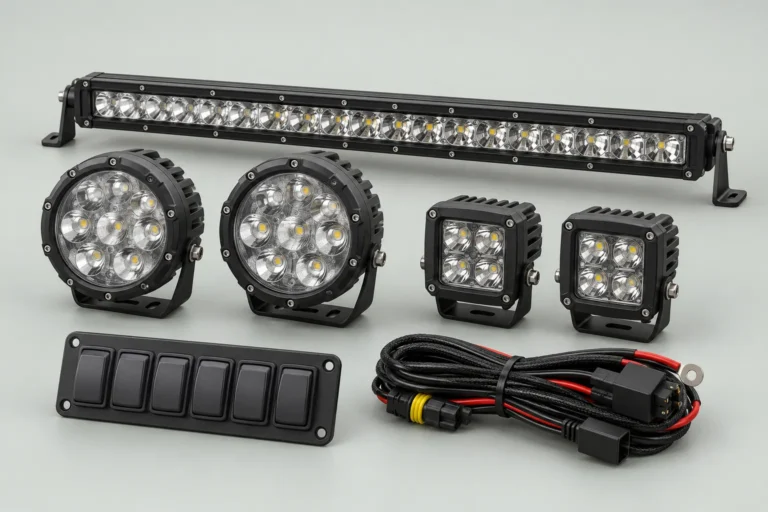
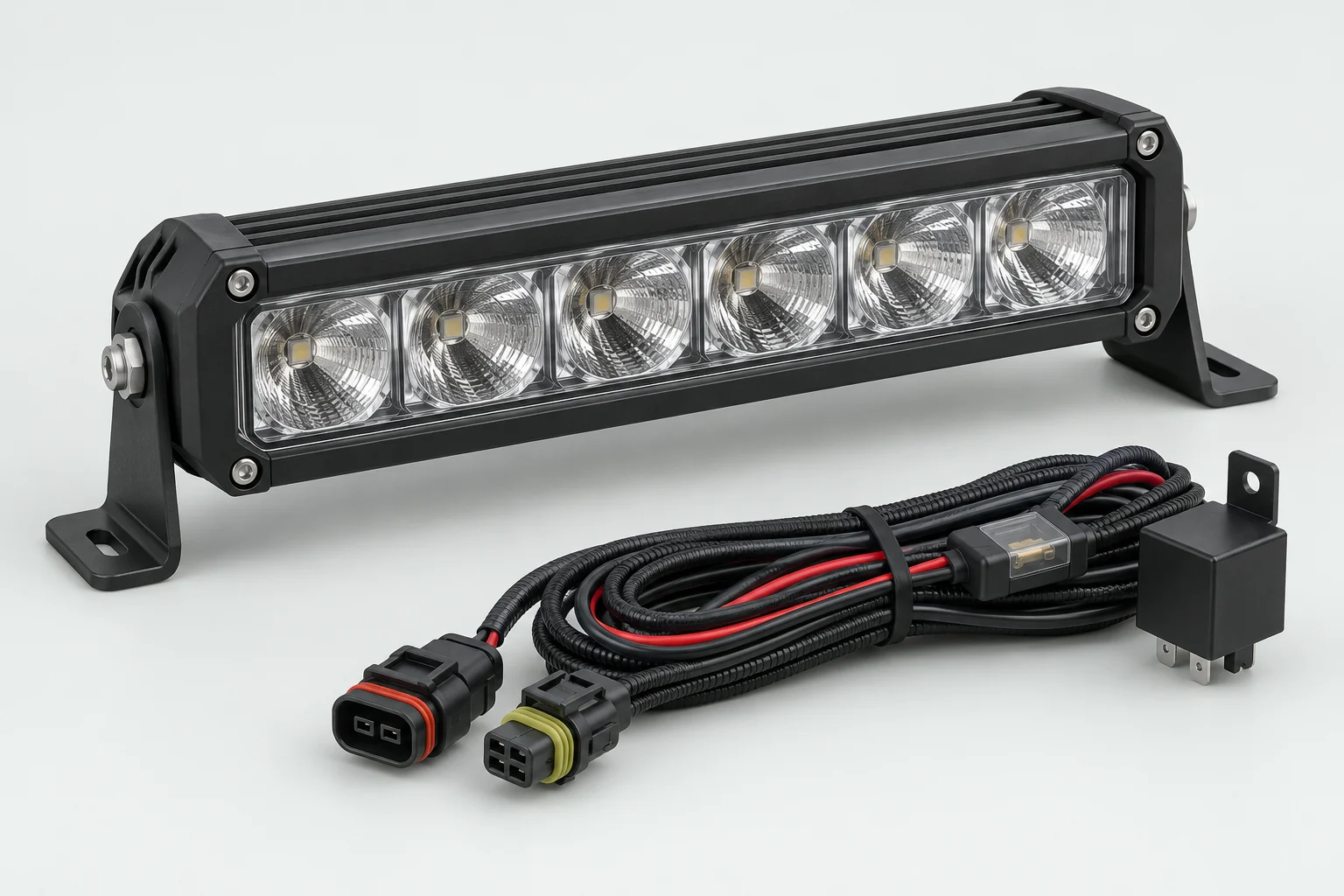
- Off-road auxiliary-light harness kits: accessory connectors, fused feeds, relays or compatible controllers, switches and mounting arrangements.
- Custom switch-panel harnesses: harness architecture for an agreed panel and defined accessory loads.
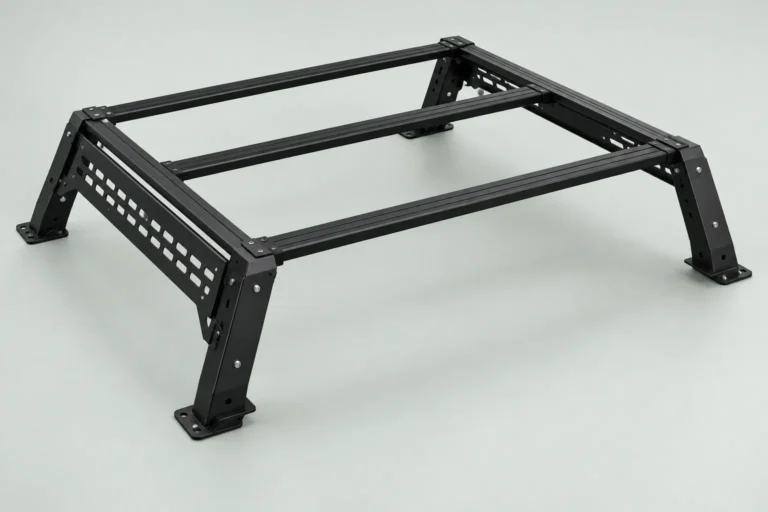
- Overlanding power accessories: suitable low-voltage wiring for additional cargo-area or camping equipment, subject to the full system design.
- Off-road accessory wiring: non-safety-critical sensor or accessory routing with clear interfaces, shielding or environmental needs where applicable.
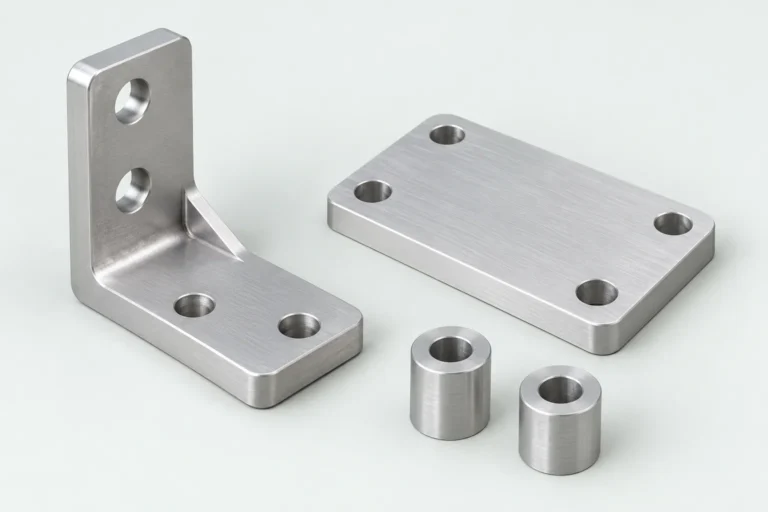
- Mounting and protection hardware: brackets, loom supports, abrasion sleeves, clips and sealed pass-through components supplied as part of an agreed kit.
Connector geometry matters more than connector appearance
Specify the complete mating pair, cavity count, keying, latch orientation, contact system and sealing arrangement. Terminal drawings or identified connector-family data are preferable to photographs alone. Buyers should record conductor range, terminal crimp specification, insertion requirements and any required secondary locks. Ask whether the connector is intended for repeated servicing and how it will be protected when unplugged.
A nominally waterproof connector can still perform poorly if cable seals do not fit the selected wire insulation, terminal crimps are inconsistent or the mating half is from another series. In an accessory wiring product, these details belong in the product specification and incoming inspection criteria.
Wire, protection and environment: what to document
Define conductor material, nominal cross-section or applicable wire size, strand construction, insulation specification and any required marking. Instead of asking for “heavy duty wire,” identify operating temperature, expected routing near hot components, chemical exposure, moisture, movement and abrasion risks. Establish sleeve, conduit, grommet and strain-relief requirements at the relevant points.
Fuse selection and current protection must be based on the complete circuit architecture, conductor protection requirements and installation conditions, not a generic amp rating pasted from a listing. Where electrical testing or market compliance is necessary, agree who will define and review the method before production.
Vehicle fitment for Wrangler, Bronco, Tacoma and other 4×4 platforms
Start with the intended vehicle platform, generation, model-year range and trim. For vehicle-specific harnesses, record whether the installation uses existing accessory mounting points, a compatible connection interface or a separate fused supply. Confirm left-hand/right-hand drive issues only where the routing or cabin placement changes. Specify the physical route, available length, attachment points and any accessory-interference concerns.
Do not infer that all Wrangler JL configurations, Bronco packages, Tacoma generations or 4Runner trims share identical accessory electrical layouts. A sample installed on one vehicle does not establish compatibility with every model year claimed in a catalog. Document the actual validation coverage and limit fitment claims accordingly.
RFQ checklist for comparable supplier quotations
| Requirement | What to provide or request |
|---|---|
| Intended modification | Accessory type, target use and circuit block diagram |
| Vehicle application | Platform, generation, trims, model years and exceptions |
| Electrical specification | Voltage assumptions, load profile, protection method and review responsibility |
| Interface | Connector family, pin assignment, mating reference and drawing revision |
| Physical harness | Wire specification, branch lengths, routing, sleeves and fixation points |
| Inspection | Visual, continuity, pinout, retention and agreed environmental checks |
| Commercial scope | Sample quantity, MOQ, tool charges, packaging and shipping destination |
How to review a first sample
Assign a sample reference and drawing revision before review. Inspect connector keying, orientation, wire markings, branch dimensions, assembly strain relief, terminals, seals, clips, fuse holders and switch labels against the approved brief. Use a controlled continuity and pinout check based on the design record. If trial installation is part of the project, record the exact vehicle and accessory configuration and the reviewer’s observations.
Separate visual appearance from electrical testing, and separate a supplier’s internal test claim from any independent evidence required by the buyer. Confirm what was actually tested, under which conditions and for how many samples. No sample review should be described as engineering certification when it is not.
Private label, packaging and installation information
For an aftermarket brand, packaging should identify the kit revision, included components, compatible applications within the supported evidence, installation prerequisites and limitations. A clear packing list reduces confusion between similar harness variants. Discuss logo ownership, approved artwork, warning statements, barcode format, spare accessories and the method for separating old versus revised stock.
Documentation should tell installers how to identify the intended components and where to obtain the appropriate validated installation instructions. Do not provide unsupported blanket claims such as “plug-and-play for every model” or “street legal worldwide.”
Quality control and repeat orders
Agree an approved master sample or drawing package, critical-to-function checkpoints, acceptable evidence and change notification requirements. For repeat orders, ask the supplier to identify any substitution of wire, terminals, seals, relay holders or connectors before shipment. Keep each variation connected to the corresponding customer SKU, vehicle range and packaging version.
If there is a field complaint, request the affected batch, photographs, installation context and a controlled technical investigation rather than immediately assuming the cause is a factory defect. Traceability allows a precise response without treating every product revision as interchangeable.
Trade and product responsibility
Country-specific rules may apply to electrical products, vehicle modifications, markings, import documentation and marketing claims. Whether a harness is intended for off-road work, on-road accessories or a controlled demonstration affects the assessment, but an “off-road only” label is not a universal exemption from applicable rules. The buyer and qualified technical advisers should determine the product’s required evaluation and claims before release.
LedgeGear 4×4 can coordinate modification-component sourcing discussions and supplier documentation. It does not imply that an accessory kit has been approved for a vehicle or market simply because a product appears on a category page.
Have a harness layout, connector reference, mounting drawing or an outline of the accessory system? LedgeGear 4×4 can help find potential manufacturers and coordinate their technical questions, sample quotations, requested revisions and production updates against your approved requirements. Explore custom manufacturing coordination or discuss your sourcing project.
Next step: send a modification-specific harness brief
If you are developing an auxiliary-light kit, branded switch-panel wiring or another non-safety-critical accessory harness, start with the vehicle platform, accessory specifications, wiring concept, reference photographs or drawings, estimated quantity and destination. State what is designed already and what still needs supplier feasibility input. See Auxiliary Lighting & Wiring, Custom Automotive Parts & Hardware and the modification-parts RFQ form for the next step.