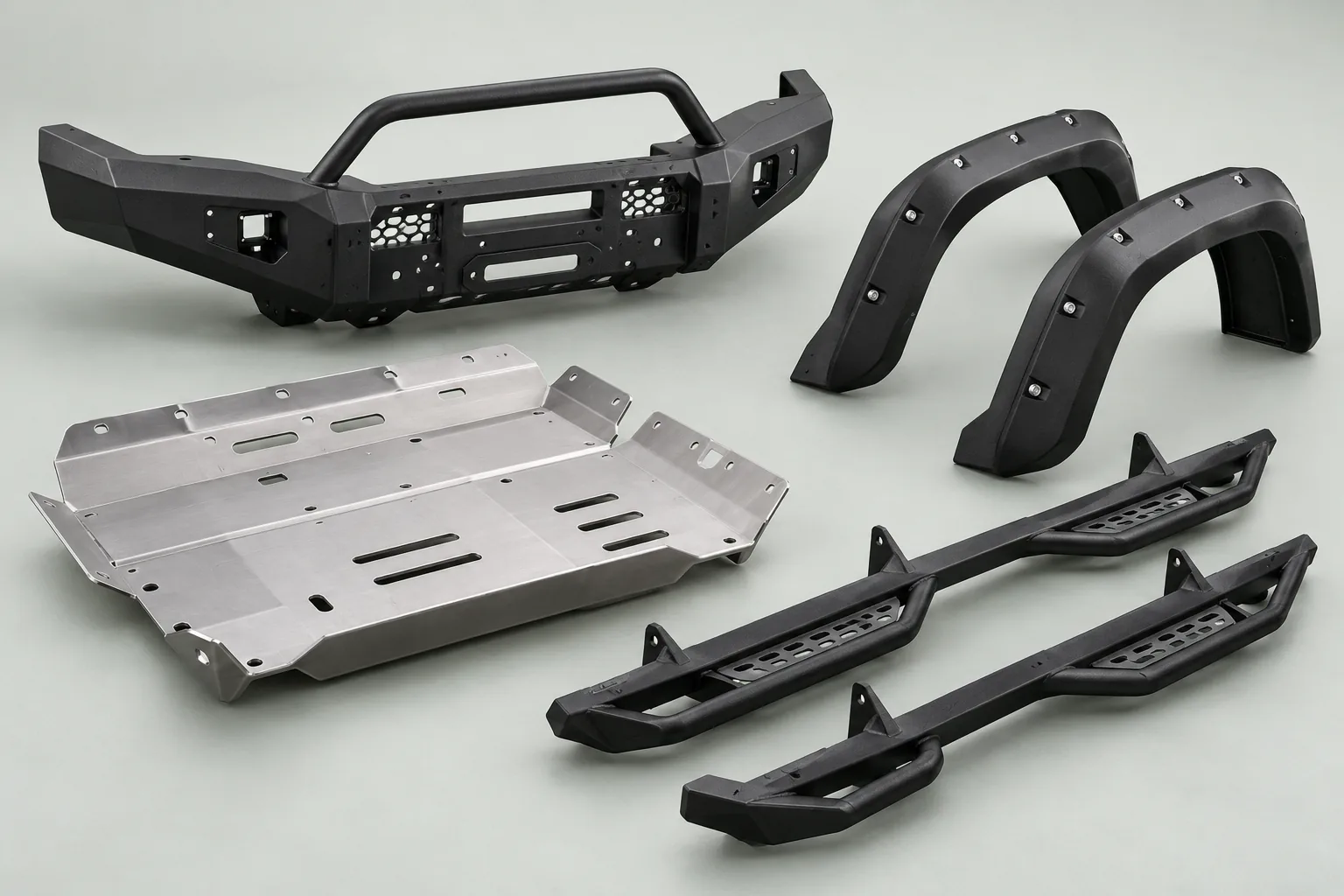
Sourcing Off-Road Skid Plates & Rock Sliders from China: B2B Guide
Skid plates and rock sliders look straightforward until the buyer asks the questions that determine whether a product can be installed and sold responsibly. Vehicle geometry, load paths, material selection, installation access, finishing and packaging all affect the outcome. This practical B2B guide explains how an importer, distributor or private-label 4×4 brand can organize an RFQ and sample review with Chinese manufacturers.
Scope: original-design aftermarket protection components for off-road trucks and SUVs. This guide covers original-design 4×4 protection upgrades, not routine factory-equivalent splash-shield replacement.
In this guide
- Start with the vehicle and intended use
- Separate protective parts into product families
- Material choice: steel or aluminum
- Design the mounting interface before the appearance
- Think beyond a static load number
- Corrosion protection and mixed metals
- A controlled sourcing RFQ
- Evaluate manufacturing capability, not just the price
- Sample approval and trial fitting
- Packaging and shipping matter for heavy components
- Private label without unsupported claims
- Production quality and repeat orders
- Commercial terms and the US destination market
- What LedgeGear 4×4 can discuss
- Copyable skid plate and slider RFQ checklist
- Common questions
- Next step
Start with the vehicle and intended use
A skid plate for a Toyota Tacoma and one for a Jeep Wrangler may protect similar systems, yet their mounting geometry, access openings and clearance constraints are different. Describe the vehicle platform, generation, engine and drivetrain, trim, suspension modifications and existing bumpers or crossmembers before discussing a drawing. Tell suppliers whether the end use is moderate trail protection, a rock-crawling build or commercial fleet work. Avoid treating a photograph or a familiar vehicle name as a fitment specification.
Separate protective parts into product families
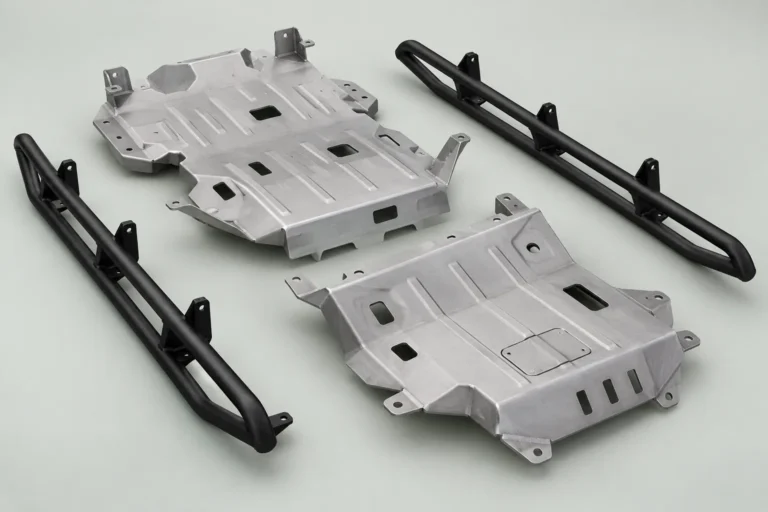
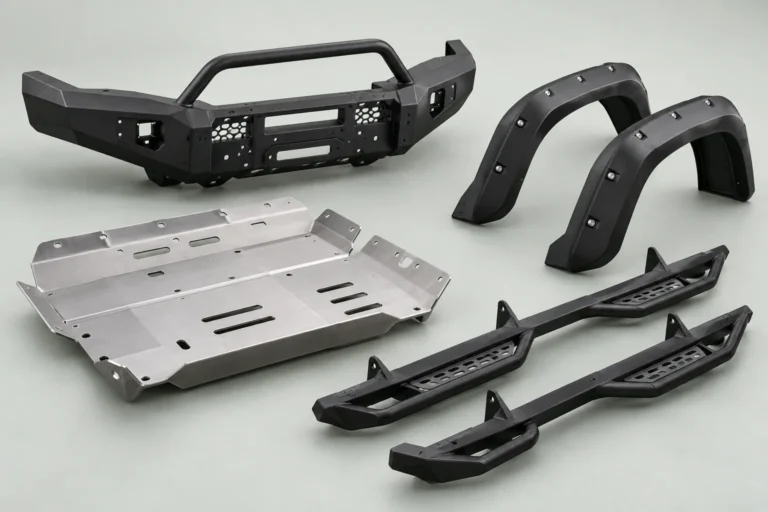
Engine, transmission, transfer-case and fuel-tank skid plates have different attachment points and maintenance constraints. Rock sliders protect the rocker area and often require decisions about mounting style and passenger step use. Differential guards, lower-arm protection, crossmember reinforcements and related brackets may require their own interfaces. Quote each assembly with drawings, fasteners, inserts, washers and installation instructions identified. A single bundled catalog price can hide important omissions.
Material choice: steel or aluminum
Steel offers design flexibility and may be appropriate where concentrated impact and abrasion are expected, but grade, nominal thickness, fabrication process and corrosion system matter. Aluminum can reduce mass, yet alloy, temper, local reinforcement, weld design and galvanic isolation require attention. Neither material is automatically superior. Ask suppliers to state the exact grade and thickness rather than ambiguous descriptions such as heavy-duty or aircraft-grade. Consider replacement availability and surface repairability.
Design the mounting interface before the appearance
A protective plate must coexist with exhaust routing, steering components, suspension travel, drivetrain movement, drain plugs, service panels and heat sources. Define the location of every vehicle attachment point and whether the design uses factory holes or additional brackets. Include fastener access with ordinary service tools. Verify the effect of aftermarket lift kits, differentials, bumpers and other common modifications. Do not rely on 3D models alone: a physical trial fit is essential for vehicle-specific products.
Think beyond a static load number
Impact resistance, attachment retention, vibration, edge deformation and ground contact are different loading scenarios. A supplier may offer a simulation image without disclosing boundary conditions or material assumptions. Ask what load path the design uses, how brackets are supported and what test evidence exists. For rock sliders, distinguish cosmetic side steps from structures intentionally designed to encounter rocks. Do not advertise jacking-point or recovery-point capacity without validated engineering evidence for the complete assembly.
Corrosion protection and mixed metals
For steel designs, define pretreatment, coating system, covered edges and inside surfaces where relevant. Powder coating alone does not prove corrosion durability if welds, threaded inserts and abrasion areas are left vulnerable. Aluminum plates fitted with steel hardware can create dissimilar-metal concerns, especially in wet or salty conditions. Discuss isolation, washers, coating maintenance and corrosion test requirements with qualified engineering and testing partners.
A controlled sourcing RFQ
Every supplier should receive the same revision-controlled drawing and requirements. The RFQ should contain: vehicle fitment range, material specification, thickness tolerances, surface finish, dimensions, weld acceptance criteria, supplied hardware, installation instructions, packaging, sample quantity, production estimate, destination, test expectations and documentation needs. Ask suppliers to list every deviation rather than silently substituting a lower-cost material or fitting.
Evaluate manufacturing capability, not just the price
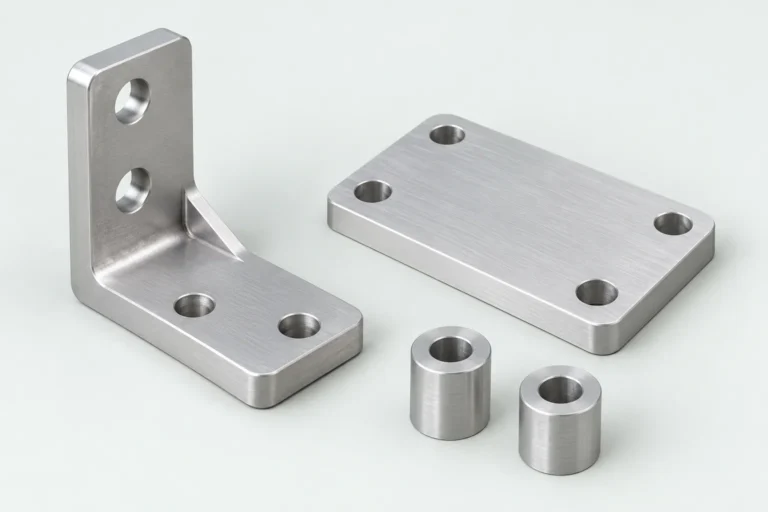
For fabricated steel protection, review cutting, bending, welding, jigs, coating and in-process inspection controls. For machined attachments, review tolerance capability and inspection equipment. Ask for relevant samples, process photos or quality records, and clarify whether coating or welding is subcontracted. Compare suppliers on like-for-like specification, packaging and inspection scope. A lower quoted unit price is not useful when the sample fails fitment or the required mounting kit is missing.
Sample approval and trial fitting
A useful sample review begins with a documented drawing revision. Record dimensions, assembly quality, coating defects, missing hardware and installation access. Where possible, conduct a controlled fitment trial on the actual vehicle variant, noting interference at realistic suspension positions. Photograph deviations with measurement references and classify each as cosmetic, functional or safety-related. Approve the revised production-intent sample, not an earlier concept piece that has since changed.
Packaging and shipping matter for heavy components
Skid plates and rocker protection may be bulky, edged and relatively heavy. Decide whether assemblies ship nested, flat-packed or fully welded. Specify carton strength, corner protection, abrasion barriers, individual hardware bags, labeling and installation instruction placement. Include packed dimensions and gross weights in landed-cost analysis. Missing accessories and freight damage can destroy margin even when factory pricing appears attractive.
Private label without unsupported claims
Aftermarket brands often want logos, branded cartons, distinctive finishes or original product variations. Confirm who owns drawings and molds, permitted use of trademarks, packaging artwork approval and whether the manufacturer may reuse the design. Marketing claims about crash compatibility, lifting, load capacity and road legality require supporting evidence. Vehicle brand names should be used only to describe application, without suggesting endorsement or affiliation.
Production quality and repeat orders
After sample sign-off, define an inspection plan based on meaningful characteristics: mounting-hole position, bend angles, weld integrity, surface finish, hardware counts and package condition. Agree on inspection records, traceability and who approves any revision. Reconfirm material, tooling, coatings and subcontractors before repeat orders. A change that seems minor at the supplier can affect real vehicle fitment.
Commercial terms and the US destination market
Clarify Incoterms, deposit structure, sample fees, tooling rights, inspection responsibilities and warranty handling. For US-bound shipments, confirm tariff classification, duties, country-of-origin marking and any safety or labeling requirements with appropriate customs and compliance professionals. Classification and landed cost depend on the actual product construction and current rules; do not reuse a generic online duty percentage across categories.
What LedgeGear 4×4 can discuss
LedgeGear 4×4 focuses on sourcing conversations for off-road protection components and related accessories. A buyer can send an original drawing or a well-defined product brief together with the vehicle platform and order quantity. Supplier capability, available designs, fitment, samples, prices and commercial terms are evaluated against the specific request, not assumed from this guide.
Have an original skid plate, slider or mounting design? Start with your drawing, photos or vehicle application. As your sourcing partner, LedgeGear 4×4 can help find potential fabricators, compare manufacturer quotations and coordinate samples, revisions and agreed production follow-up. Explore custom manufacturing coordination or discuss your sourcing project.
Copyable skid plate and slider RFQ checklist
- Vehicle make, model, generation, trim and installed modifications
- Product assembly and mounting interface drawings
- Target material grade, thickness, finish and component weight
- Fasteners, brackets, supplied installation kit and instructions
- Load cases, acceptance criteria and relevant validation evidence
- Sample approval and production revision process
- Quantity, packaging, destination and expected order schedule
- Compliance, labeling and intellectual-property responsibilities
Common questions
Can a supplier guarantee fitment from a vehicle model name?
No. Model year, trim, installed modifications and the actual mounting geometry matter. Request dimensioned interfaces and a physical trial fit before claiming compatibility.
Is thicker always stronger?
No. Material grade, geometry, attachments, welds, reinforcement and load direction can be more influential than one thickness figure.
What should you verify for private-label skid plates?
Confirm drawing ownership, material and finish, installation documents, declared applications, sample approval, packaging and any marketing claim requiring validation.
Next step
Explore Skid Plates, Rock Sliders & Underbody Protection, browse off-road vehicle platforms, or send your sourcing brief for a project-specific discussion.